
A Travel and Expense Policy Checklist for Indian Companies
A practical checklist for writing a travel and expense policy in India: who it covers, limits by category and city, approvals, receipts, GST and advances.
Most companies have a travel and expense policy. Fewer have one that an employee can follow without calling finance. The test of a policy is simple: can a new joiner read it once and file a correct claim, and can an approver decide without opening a spreadsheet?
This checklist is for finance teams in India that are writing a policy for the first time or tidying up an old one. It does not tell you what your limits should be. That depends on your business. It tells you what the policy has to answer.
1. Say who and what the policy covers
Start with scope. A policy that is silent on a group of people will be argued about later.
- Which companies and locations in the group it applies to.
- Which people: employees, contract staff, consultants, directors, guests of the company.
- Which kinds of spend: travel, local conveyance, meals, client entertainment, mobile and internet, office purchases.
- What is paid directly by the company and what the employee pays and claims back.
2. Set limits by grade, category and city
Limits are where most disputes start, so be specific.
- Group employees into a small number of grades. Three to five is usually enough.
- For each grade, set a limit for each category: hotel per night, meals, local travel.
- Class Indian cities into tiers. A hotel in Mumbai and a hotel in a smaller city should not share one limit.
- Say what the travel class is for each grade and for each mode: air, rail, road.
- Decide how far ahead a trip must be booked, and what happens when it is not.
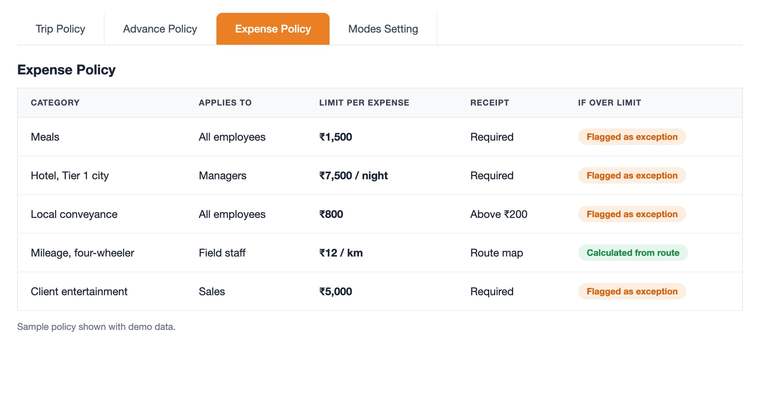
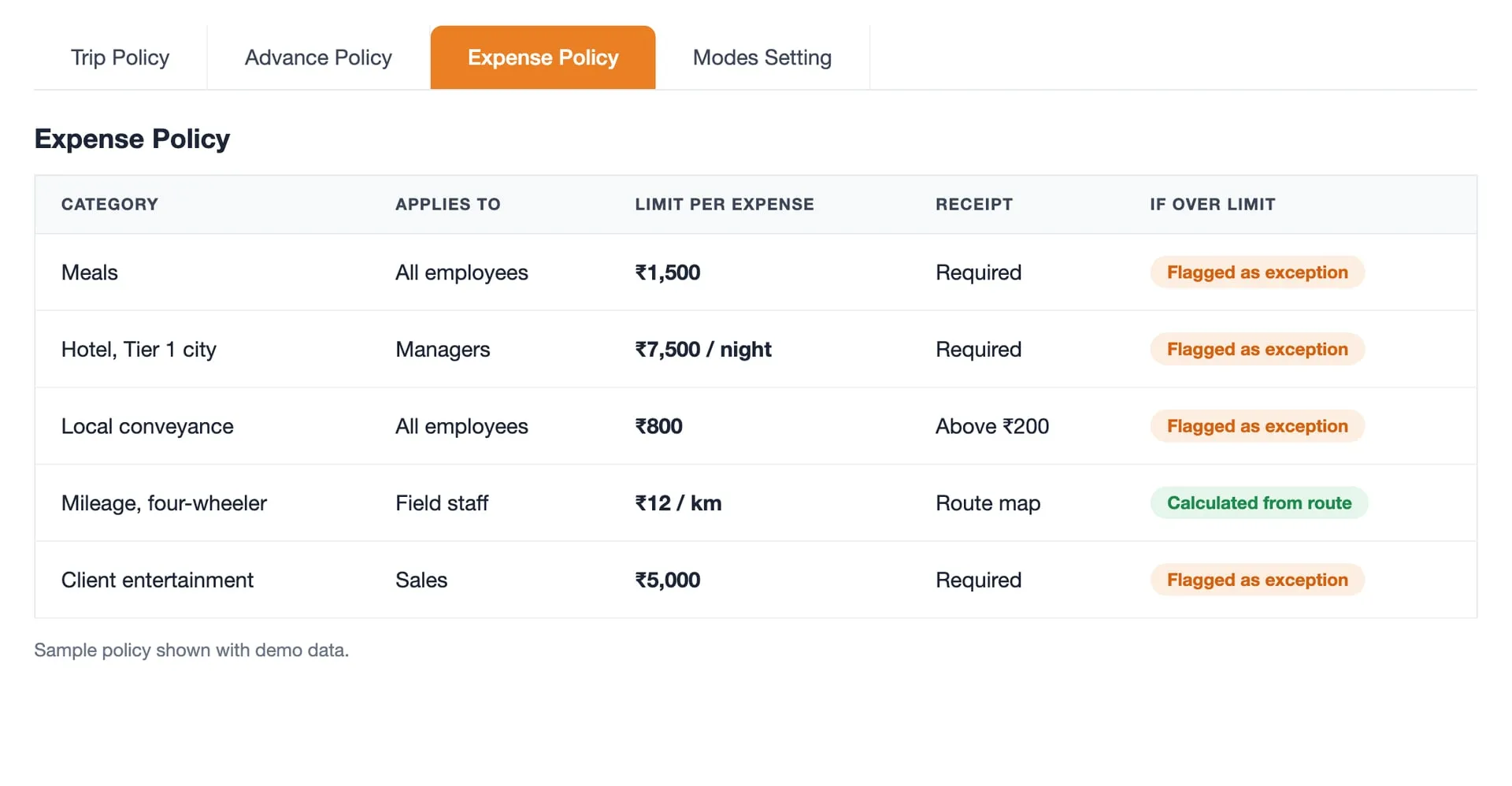
Write the limits in a table, not in sentences. A table can be loaded into a system. A paragraph cannot.
3. Decide what needs a receipt
Say plainly when a receipt is needed and what counts as one.
- The amount above which a receipt is mandatory, by category.
- What a valid receipt shows: the vendor name, the date, the amount and the tax details.
- What an employee does when a receipt is lost. A signed declaration up to a small amount is common.
- How long after the spend a claim may be filed.
4. Write the approval path
An approval path answers three questions: who approves, in what order, and what happens when they are away.
- The levels for each kind of request. A trip may need the manager only. A large claim may need the manager and then finance.
- The amount or condition that adds a level.
- Who approves when the approver is on leave. Name the rule for delegation, not a person.
- How long each approver has before a reminder goes out.
5. Handle exceptions in the open
No policy covers everything. What matters is that an exception is visible and someone owns the decision.
- Say who can approve a claim that is over a limit.
- Ask for a reason in writing each time.
- Keep the exception on record with the claim, so that a later review can see it.
6. Cover the tax details
Expense claims carry tax consequences. Your policy should tell employees what to collect, and your tax adviser should tell you what the law needs. Do not rely on a blog post for that.
- Ask for a tax invoice in the company name wherever the vendor can issue one.
- Tell employees which details must be on the invoice.
- Decide who checks those details and when.
7. Set the rules for advances
- Who may ask for an advance, and for what.
- When the advance must be settled after the trip ends.
- What happens to an advance that is not settled.
8. Mileage and personal vehicles
- The rate per kilometre for each kind of vehicle.
- How the distance is worked out. Use the route, not the employee’s estimate.
9. Review it every year
Rates change, cities grow, and the company adds grades. Put a review date on the policy and name the person who owns it.
How Xpense handles this
A policy only works if it is applied the same way to every claim. In Xpense you set the policy up once and the system applies it.
- Trip requests carry your travel policy and city-class limits.
- Every claim is checked against your policy when it is submitted. The check is rule-based.
- Approval workflows are multi-level, configurable per module and company, with delegation.
- Mileage is calculated from the route and your vehicle rate.
- GST details are captured and validated at submission and included in report exports.
- Approvals and actions are logged, and every trip, expense and advance has a timeline.
If you are rewriting your policy, bring the draft to a demo. It is the best way to see whether a rule you have written can be applied by a system.
See expense claims and policy checks and approval workflows.