
Advances, Petty Cash and Settlement: Closing the Loop
How to run travel advances and petty cash so that every advance is settled: the request, the limits, the settlement deadline and the reconciliation.
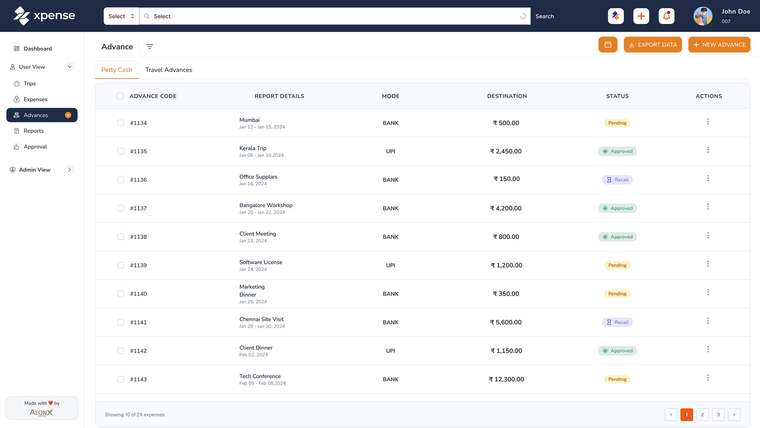
An advance is the company’s money in an employee’s pocket. Petty cash is the company’s money in a drawer. Both are useful, and both are easy to lose track of. Ask a finance team how much is out in open advances today, and many cannot answer without a day of work.
This article describes a way to run advances and petty cash so that each one is opened, used and closed, and so that the open balance is known on any day.
Why advances go wrong
The problems are the same in most companies.
- An advance is given and nobody records what it was for.
- The employee comes back, files the expenses, and nobody sets them against the advance.
- The balance is small, so nobody asks for it.
- The employee takes a second advance while the first is still open.
- At the year end, there is a list of old advances that nobody can explain.
Each of these is a missing step, not a bad person. The fix is to make the steps part of the process.
Step one: a request with a purpose
An advance should never start as a phone call. It starts as a request that says:
- Who is asking.
- How much, and in which currency.
- What it is for: a named trip, or a period of local spend.
- When the employee expects to settle it.
Tie a travel advance to the trip. Then the advance, the bookings and the later expenses are all found in one place.
Step two: limits and approval
Decide in the policy how much may be advanced and who approves it.
- A limit by grade, or a share of the estimated trip cost.
- A rule that there can be only one open advance per employee, or per trip.
- An approval path. The manager confirms the need. Finance confirms the amount and that no earlier advance is open.
The check for an open advance is the most useful control here. It is also the one most often skipped, because it means looking the employee up.
Step three: issue and record
When the advance is paid, record the date, the amount, the mode of payment and the reference. From this moment the advance is an open item against the employee, and it should appear on a list that finance can see.
For a trip abroad, the advance may be in a foreign currency. Record both the foreign amount and the rupee value, and decide in the policy which rate applies at settlement.
Step four: spend against the advance
While the employee travels, their expenses are set against the advance. This is the step that keeps the picture true. The employee and finance should both be able to see:
- The advance issued.
- The expenses filed against it so far.
- The balance left.
When this is visible during the trip, the settlement at the end is not a surprise to anyone.
Step five: settle by a deadline
Set a deadline for settlement, counted from the end of the trip. Seven to fifteen days is a common range. At settlement, one of three things is true.
| Situation | What happens |
|---|---|
| Expenses equal the advance | The advance is closed |
| Expenses are lower than the advance | The employee returns the balance |
| Expenses are higher than the advance | The company reimburses the difference |
Whichever it is, the advance is closed with a record of how. An advance should never simply disappear from the list.
Decide what follows a missed deadline. A reminder first. Then, by your policy, perhaps no new advance until the old one is closed. Whatever the rule is, apply it to everyone.
Petty cash is the same idea
Petty cash is an advance given to a location or a custodian instead of a traveller.
- A named custodian is responsible for the float.
- Each payment out has a voucher and a receipt.
- The float is topped up against the vouchers, so that cash plus vouchers always equals the float.
- Someone other than the custodian counts the cash at intervals.
The top-up is the settlement. If the vouchers are not in order, the float is not refilled.
Reconcile every month
Once a month, finance should be able to produce two lists without effort.
- Open advances by employee, with the age of each.
- Petty cash floats by location, with the date of the last count.
Anything older than your settlement deadline needs a name beside it and a date for closing. Review the list with the business heads. Old advances get settled when a manager is asked about them.
Record it in the books correctly
An advance is not an expense when it is paid. It becomes an expense when the employee accounts for it. Until then it sits on the balance sheet as an amount due from the employee. Your accounting system should reflect both moments: the issue of the advance and its settlement against approved expenses.
How Xpense handles this
- Advances, petty cash and settlement are tracked end to end, in more than one currency.
- Approval workflows are multi-level, configurable per module and company, with delegation.
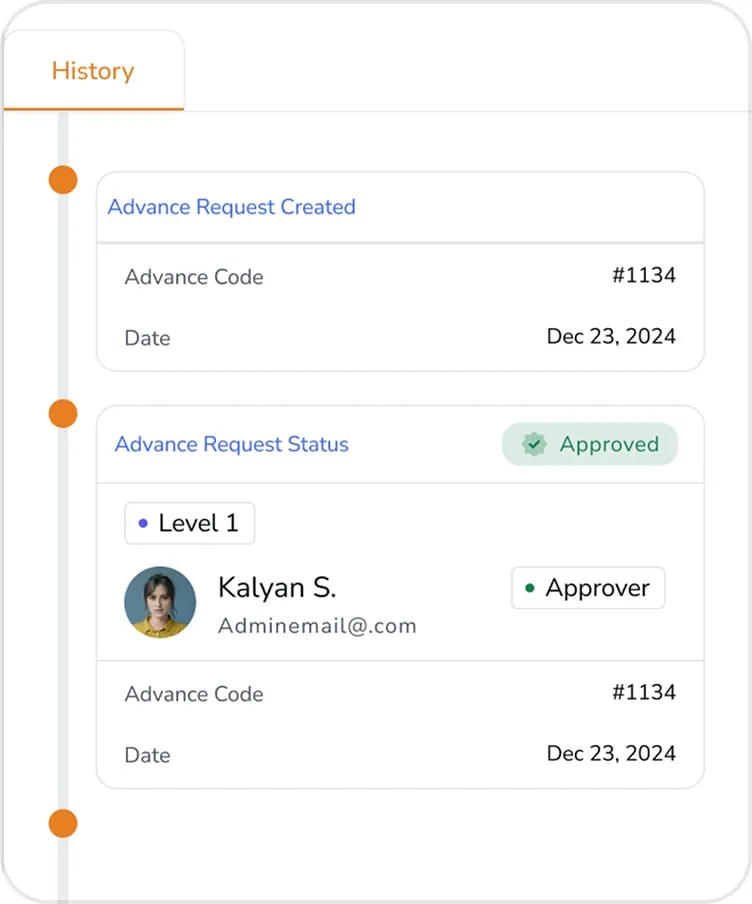
- Every advance has a timeline of its approvals and actions.
- Approved expense reports are posted to SAP, with GL mapping.
The rules in this article, such as limits and deadlines, are yours to set. Xpense keeps the record of each advance from the request to the settlement.